

Korea standard time is 9 hours ahead of Greenwich mean time (GMT +9).
Korea is geographically located in the mid-latitude temperate climatic zone, experiencing four distinct seasons: spring (March-May), summer (June-August), fall (September-November), and winter (December-February).
ICIMC2026 is scheduled to be held in June, and if you visit Korea during this time, you will be able to enjoy the beautiful summer scenery with clear skies and refreshing breezes. The weather during this period is warm and humid, with temperatures ranging from 20°C to 30°C and occasional rainfall, with an average precipitation of 70.2 mm.
Government office hours are usually from 9:00 to 18:00 on weekdays. Banks are open from 9:00 to 16:00 on weekdays. Although most stores are open every day from 10:30 to 20:00, including Sundays, please check the website of the location that you would like to visit.
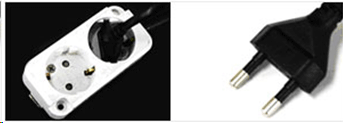
Korea uses 110 and 220 volts, 60 cycles system but the standard voltage is 220 volts. Regarding the shape of outlet, Korea use ‘Round pin attachment plug’ type. Please check up your plug and prepare the adapter, if necessary.
To make an international call, first dial the international dialing code (001, 002 or 00700), then the country code, area code, and finally the individual number. You may rent a cell phone at the airport.
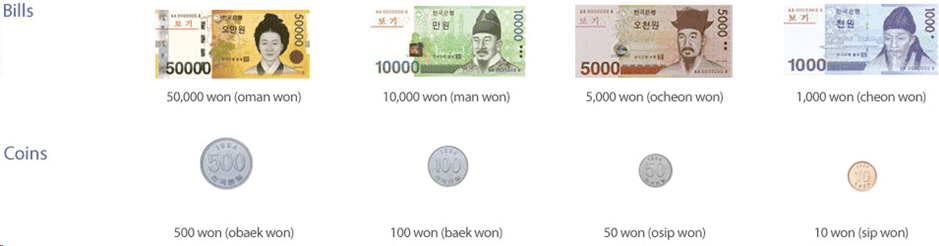
The unit of Korean currency is the won (₩). Coin denominations are ₩10, ₩50, ₩100, and ₩500. Banknotes are ₩1,000, ₩5,000, ₩10,000, and ₩50,000.
Most global credit cards are widely accepted at hotels, shops, and restaurants in Korea. Check with your credit card company for details about use abroad.
Value-Added Tax (VAT) is levied on most goods and services at a standard rate of 10% and is included in the retail price. In tourist hotels, this 10% tax applies to rooms, meals, and other services and is included in the bill.
Tipping is not a regular practice in Korea. Service charges are included in your bill for rooms, meals, and other services at hotels and upscale restaurants. Koreans occasionally tip when they are especially pleased with the service they receive.
119 Emergencies for Fire, Rescue, and Hospital Services
112 Police
Check out the useful expression in Korean below.
| Hello! | annyeonghaseyo | 안녕하세요 |
| Good-bye. | annyeonghi gaseyo | 안녕히 계세요 |
| Thank you. | gamsahamnida | 감사합니다 |
| I’m sorry. | mianhamnida | 미안합니다 |
| Excuse me. | sillyehabnida | 실례합니다 |
| It’s okay. | gwaenchanhseubnida | 괜찮습니다 |
| You’re welcome. | cheonman-eyo | 천만에요 |
| Good. | johseubnida | 좋습니다 |
| Would you give me a help? | dowa juseyo | 도와 주세요 |
| Korea Tourism Organization | |
| Korea Immigration Service | |
| Ministry of Foreign Affairs and Trade | |
| Incheon International Airport | |
| Seoul Tourism Organization |